
Evolving your AML/CTF approach to outcomes, not compliance, with a wider focus area
Key highlights:
- KYC now requires a broader approach, blending identity data with behavioural data to identify risk patterns.
- Criminals are using complex corporate ownership structures to hide behind, making interconnected commercial data critical for KYB.
- Successful KYP needs to blend the technology of regular screening with interpersonal conversations to help detect risk.
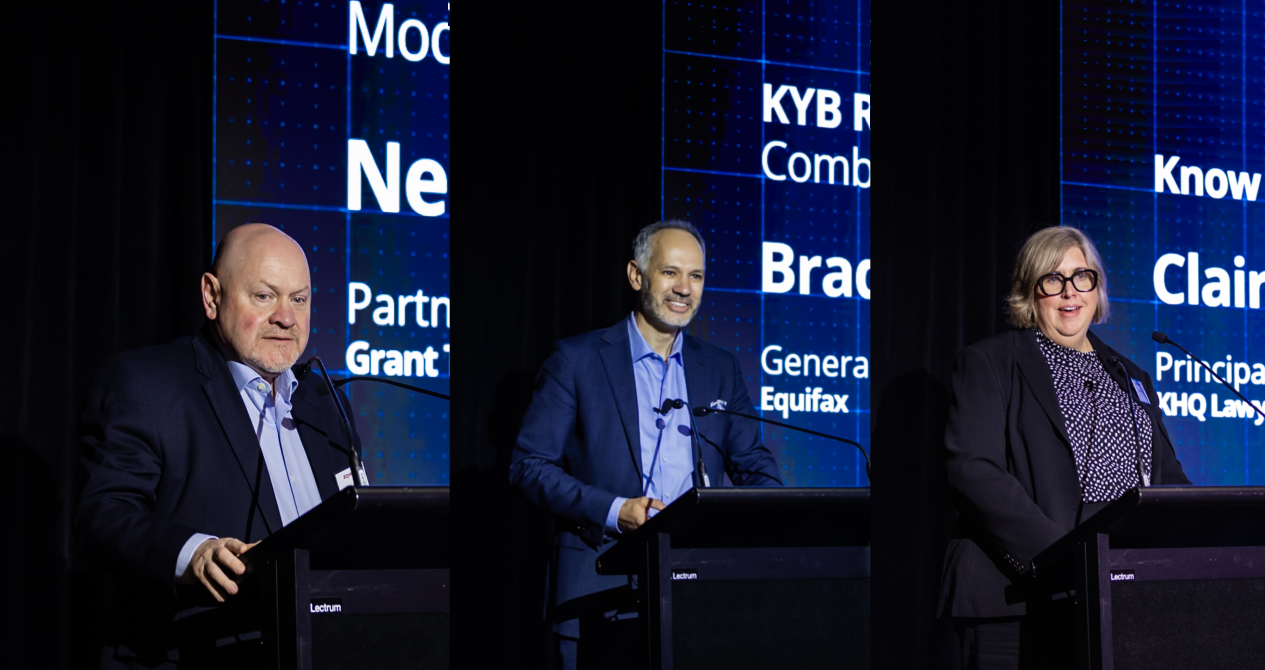
Equifax Australia hosted senior financial services leaders, risk executives, and compliance specialists at the Equifax Australia AML/CTF Summit 2026 to address the critical operational shift facing reporting entities following recent regulatory reforms.
As well as a highly informative presentation from AUSTRAC Chief Executive Officer, Brendan Thomas, on the reforms and AUSTRAC’s regulatory expectations, there were presentations and panel discussions on each of the three core pillars: Know Your Customer, Know Your Business and Know Your Personnel.
Identity is both who you are and what you do: a broader approach to Know Your Customer
In his Know Your Customer (KYC) presentation, ‘Digital Identity as the Foundation of Modern AML/CTF Frameworks’, Neil Jeans, Partner, Risk Consulting, Grant Thornton (image above, left) talked us through the evolution he has seen in almost 30 years working in AML/CTF compliance.
Neil described the latest reforms as the most significant change he’s seen in a lifetime working in anti-money laundering, both in financial services organisations and in law enforcement and investigation.
In Neil’s view, one of the most important evolutions of the current reforms is the way identity is thought about. He says it is two-fold: one, who you say you are and two, what you do. “We’ve never really been in a position up until recently to tackle the second part of that, what you do, in a meaningful and structured way,” said Neil.
It is this level of what Neil calls observed identity and dynamic identity that will unlock new capabilities for detecting and preventing AML/CTF. According to Neil, this will help organisations to address questions like:
- What are people doing?
- How are they behaving?
- What are they doing with us?
- Does it make sense?
- Are they suddenly changing things?
In particular, Neil pointed out that the way young people use technology, engage with each other, and think about their own identity is very different to older generations. “These are all sources of data that we need to start to think about how we actually harness and use to solve our problem, which is ultimately making sure that we know who our clients truly are,” he said. Ultimately, Neil believes that the private sector has significant levels of information and can use this to identify patterns and activity faster than law enforcement can sometimes manage.
It is the capacity to collate multiple data sources and multiple records together that will be the true test of an organisation’s capacity to meet the regulatory requirements. “Most major financial institutions, if you speak about the single customer view, they just laugh nervously. It’s a significant challenge, but we will hopefully get better and better at this,” commented Neil, pointing out that integration of systems is critical to overcoming the sophistication of bad actors.
Key takeaway: Its about combining multiple data sources to create a more comprehensive view of who your customers are and if their activity and behaviours are aligned with expected patterns.
Piercing the armour of corporate ownership structures: leveraging connected data to address Know Your Business requirements
Next we heard from Brad Walters, General Manager Commercial, Equifax (image above, centre) on Know Your Business (KYB) with the presentation, ‘Combatting Financial Crime with Confidence’. Brad shared how his interest in AML/CTF probably started as a teenager, when he was obsessed with detective novels and who-dunnit games. But while the hook remains joining the various dots to expose the culprit, in today’s world of financial crime, the stakes are higher than ever.
“The culprits aren’t hiding in the conservatory with the candlestick. They’re hiding behind corporate structures, layered trusts, and offshore shell companies,” said Brad. “We’re up against highly sophisticated, organised networks. We’re tracking syndicates of bad actors who are working in concert across a whole ecosystem of shadow directors and professional enablers, including complicit legal and financial advisors, to evade detection. The threat is no longer a single piece on the board, it’s the whole network itself.”
Effective KYB is about identifying the hidden connections and multi-tiered structural layers to understand real ownership and control. Some of Brad’s key points included:
- Criminals are using complex ownership structures as a weapon to conceal their actions, including discretionary trusts, complex partnerships and multi-share class companies
- Traditional approaches like a 25% ownership test are being bypassed and a lack of moderate ownership can no longer be equated with a lack of influence
- Risk often lies behind the names on the paperwork
- Connecting data like addresses and associated businesses can play a key role in real-time dynamic business and risk mapping
- Using interconnected sources of commercial intelligence data is critical for tracing every link in the corporate chain.
“This means you can flag the influential bad actors operating from the shadows, as well as identifying those who may have an association with foreign politically exposed persons. Like for KYC, it’s not just who they are but what they do that helps to identify suspicious actors and high-risk trading patterns,” said Brad.
Technology will be critical for balancing comprehensive investigation with the high-speed customer experience people increasingly expect. This means using systems that can:
- Leverage connected data networks to quickly map traceability across business structures and people
- Enable intelligent document processing for automated information extraction
- Perform continuous entity surveillance with automated triggers for events like changes in directorship, a shift in shareholders, a change of address, significant transactions, or new sanctions alerts.
“Institutions require absolute clarity on who they’re doing business with, and we can meet that challenge by combining comprehensive, up-to-date and connected data networks to help map out those complex structures, utilising intelligent document processing to extract the hidden controllers, and applying continuous surveillance for early identification and intervention with the right humans in the loop to support the delivery of the right outcomes. This is how we protect our institutions, all while delivering the frictionless onboarding experience that our customers expect,” concluded Brad.
Key takeaway: Criminals are using complex corporate structures to hide behind. The future of AML compliance relies on leveraging connected commercial intelligence.
Creating cultures of disclosure and action: The conversations that matter for Know Your Personnel
The third focus area of the AML/CTF regulatory changes is Know Your Personnel (KYP), also sometimes referred to as Know Your Employee (KYE), with employment lawyer Claire Brown, Principal, KHQ Lawyers (image above, right) sharing her insights.
One of the key risks for organisations is their own people. As Claire said, “the call is coming from inside the house,” with the risk of both bad actors within your organisation, as well as what Claire refers to as ‘desperate actors’ - people who are easily preyed upon by criminal networks. And it’s worth noting that KYP is about more than your direct employees. It should also include:
- Temporary staff
- Contractors
- Volunteers
- External advisors.
Claire pointed out that it’s not just about having the right systems in place, it’s also about building an organisational culture that ensures the next step of investigation and verification takes place.
“A lot of my experience has been in areas of workplace relations like unlawful workplace behaviour or internal fraud investigations. And what I find is that a lot of times when I’m having conversations, people will say ‘yeah, we knew there was something a bit dodgy about him’ or ‘we knew she wasn’t quite right’ and I’ll say ‘great, so did anyone actually escalate that?’ and the answer is no,” said Claire. “You need to make sure there’s a response when the adverse result is triggered, and that there’s regular rechecking and reverification.”
Claire also pointed out that the risk is both for intentional bad actors who are actively involved in criminal processes, and for inadvertent infiltration. Training is an essential element in helping to protect your people from unintentionally enabling crime, and feeling that they can come forward to report any issues if something feels not quite right.
“We see situations where senior people ask ‘how could someone steal $2 million out of our payroll without our knowing?’ And it’s because no-one’s telling you that something’s not quite right about them, like maybe they’re in financial difficulty, or they’re telling you and you’re not listening,” said Claire.
This means an effective KYP strategy needs to:
- Leverage technology for employee and people screening, like police checks and qualification verifications
- Enable ongoing screening and reverification, both periodically and trigger-based
- Regular one-on-one conversations to help pick up on ‘gut feel’ if something isn’t right with an employee and processes to escalate any concerns
- Building a strong culture of disclosure where people have effective training on risk and know how to report potential issues.
Key takeaway: It’s not just about having systems to identify issues, it’s about having a culture of verification and acting on the red flags.
The expertise to help you navigate AML/CTF obligations
Equifax helps businesses across the AML lifecycle, including Tranche 2 compliance requirements. Whether you need to on-board new customers quickly, or implement an ongoing Customer Due Diligence program, we can provide you with the data, solutions and support to monitor risk across individual customers, non-individual customers (companies) and employees.
This means you can automate AML workflows while having a high-level assurance to help gain deeper insights into the business or person you are working with. This includes tools and solutions to help you:
- Collect information directly from customers
- Verify businesses and beneficial ownership
- Verify and identify individuals
- Automate ongoing customer due diligence.
To explore our products and learn more about how Equifax’s AML and due diligence solutions can help your business,
reach out to our team.
Disclaimer: The information contained in this article is general in nature and does not constitute personal, financial, legal, or tax advice. It does not take into account your personal objectives, financial situation or needs. Therefore, you should consider whether the information is appropriate to your circumstance before acting on it, and where appropriate, seek independent professional advice. Correct as of July 2026.
Related Posts

Following its support of The Gender Index Australia, the research highlights how leadership gender diversity can help mitigate financial risk and protect bottom-line capital.

Inaugural iCIRT Construction Index reveals a severe delivery deficit, with small construction business exits up +58%, asset finance down -6.5%, and 35% of Australians unable to absorb more than a 5% cost overrun.