
The Olympic Paradox: Megaproject Pressures on Queensland’s Building Sector
As the clock ticked past midnight on 1st June 2026, the Games Independent Infrastructure and Coordination Authority (GIICA) officially took ownership of the Victoria Park site in Brisbane, paving the way for early works on a $3.60bn, 63,000-seat Olympic stadium.
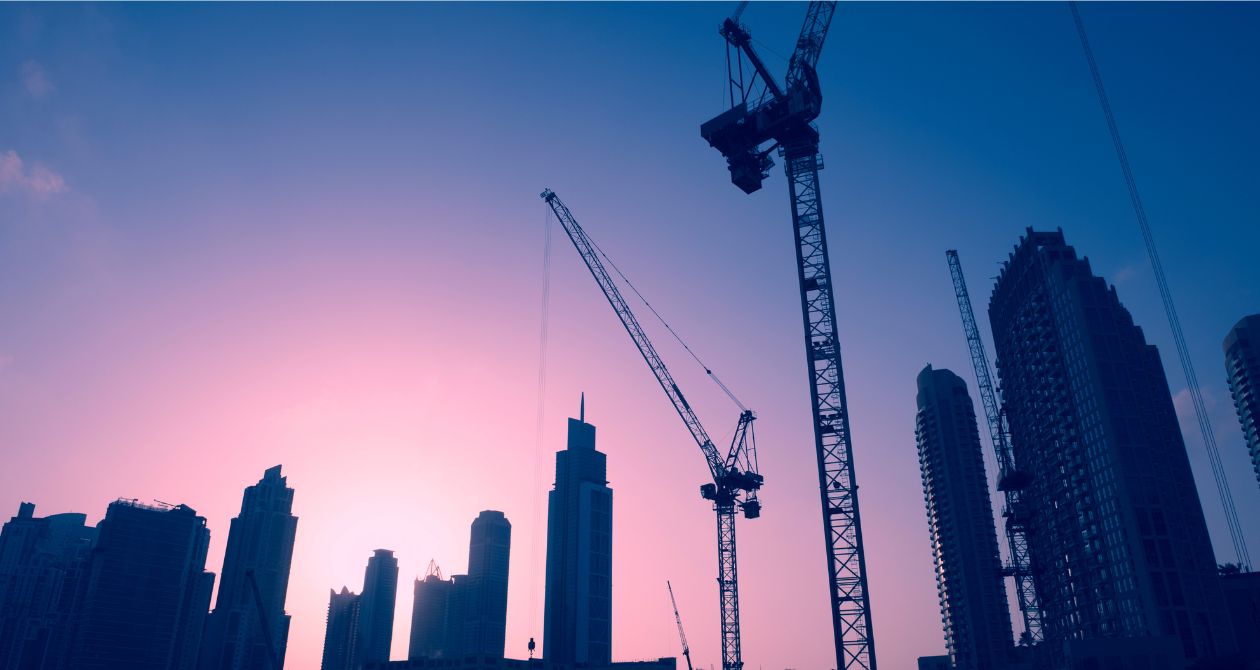
The commencement of construction was marked by the removal of protest camps, with Premier David Crisafulli warning that while citizens can express differing views, they cannot do so "running in between excavators and bulldozers".
However, while the physical roadblocks and political friction at Victoria Park dominate the headlines, the most dangerous hurdles facing the 2032 Olympic and Paralympic Games are strictly financial.
As Queensland stands on the precipice of a historic infrastructure super-cycle, the state’s successful bid to host the Brisbane 2032 Olympic and Paralympic Games has catalysed a wave of development. However, evaluating this landscape reveals a complex web of systemic risks. While headline figures project unprecedented prosperity, the underlying market mechanics - driven by capacity constraints, plummeting productivity, and an unyielding Olympic deadline - suggest the potential for a perilous "hollow boom".
To accurately assess the risk of firms operating within this environment, we must dissect the economic pressures of megaprojects, historical cost blowouts, and the operational vulnerabilities threatening the Queensland construction supply chain. This risk must also be evaluated against the backdrop of ongoing geopolitical volatility in the Middle East. This instability is likely to exert both immediate and protracted pressure on input costs, potentially disrupting the supply chain for the Olympic infrastructure program and the broader state development pipeline.
The Illusion of Size and the Reality of Concentrated Demand
When assessing the financial impact of Brisbane 2032, it is crucial to recognise that the direct Olympic price tag is relatively modest compared to the state's broader expenditure. The core venue infrastructure program is budgeted at $7.10bn, encompassing 17 new and upgraded venues.
In isolation, this venue spend is manageable. The true risk emerges when contextualising it against Queensland’s staggering $127.50bn five-year major engineering pipeline (refer Table 1). The Games-related construction, which totals closer to $11.20bn when including precincts and athlete villages, represents a fraction of the total market. Yet, it possesses characteristics that standard civil projects lack, including a high degree of schedule inflexibility.
Standard projects—such as road upgrades or hospitals—can extend schedules to navigate supply bottlenecks. The Olympic opening ceremony, however, is an unpostponable deadline. Consortiums delivering these venues are often compelled to secure resources at any cost. This inelastic demand distorts spot prices for materials and skilled trades, initiating a chain reaction that starves concurrent developments.
Table 1 - The Illusion of Size – Olympic Spend vs. Total Queensland Pipeline
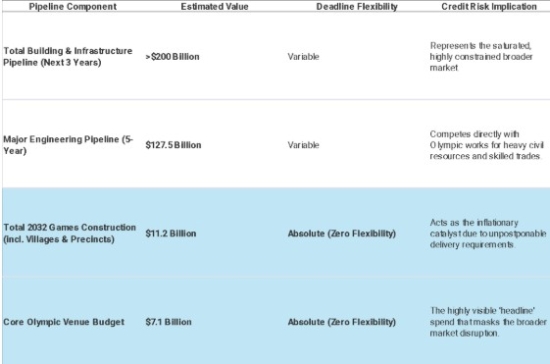
Source: WT Advisory Report 2024; QMCA Major Projects Pipeline 2025; CSQ Industry Outlook 2025-26; Queensland Government 2032 Delivery Plan.
With outsourced services ('intermediate services input') accounting for nearly 47.0% of all input costs across the sector, exposure to spot-price volatility remains high. However, to avoid a repeat of the catastrophic margin compression placed on fixed-price contracts during the post-COVID period, construction companies have fundamentally shifted their risk models. Firms have increasingly tilted towards utilising cost escalation clauses and contract variations. According to Infrastructure Australia, 51.0% of surveyed businesses have sought a contract variation over the last 12 months, utilising them as a pre-emptive tool to recover costs and frequently factoring at least 10.0% cost variations into their initial budgets. While this mitigates immediate default risk for contractors, it effectively pushes the hyper-escalation risk back onto the principals and the government.
Queensland’s Spending Super-Cycle: Past vs. Present
To comprehend the scale of this capacity challenge, we must compare Queensland's current trajectory with its previous economic peak. Between 2011 and 2016, during the height of the resources boom, Queensland’s engineering construction industry delivered over $70.00bn of works.
The current pipeline represents a massive escalation. Over the next five years, the engineering pipeline requires the delivery of $127.50bn. The sector must increase its output by at least 60.0% just to deliver currently funded works, and by more than 150% to meet the peak output required by the total pipeline.
Furthermore, today's boom is a multi-sector collision. Contractors are concurrently executing a $18.5bn Hospital Rescue Plan, a massive energy transition roadmap, and the 2032 Games infrastructure, meaning they are fiercely competing for a finite pool of general construction labor across the state.
The Megaproject Curse: A Global History of Blowouts
Assessing the risk of Olympic-exposed firms requires acknowledging a stark statistical reality: the Olympic Games are the only type of megaproject that has historically rarely been delivered on budget. A comprehensive Oxford University study found that 100% of the Games experience cost overruns, averaging a staggering 159% in real terms.
Table 2 - Cost Overruns of the Olympic Games 1960-2024
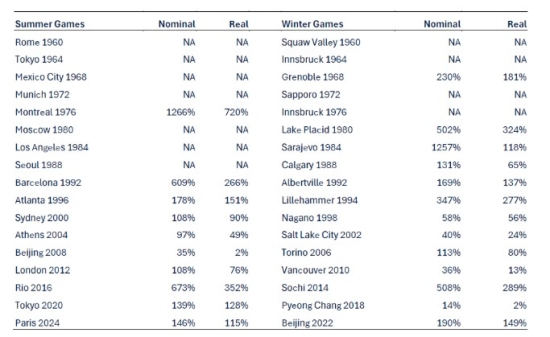
Source: The Oxford Olympics Study 2024
The IOC’s recent "Agenda 2020+5" reforms aimed to reduce costs by promoting the reuse of existing venues. However, this appears to have had a limited impact on curtailing cost escalation. The recent Paris 2024 Games incurred a 115% real-term cost overrun, reaching an estimated USD $8.70bn.
Researchers attribute this persistent failure to an uncapped funding dynamic. Because the scope is rigid and the deadline immovable, the initial bid acts merely as a down payment—historically averaging just 38.0% of the final cost. When problems arise, project managers frequently face challenges trading off schedule for cost; they are often required to authorise uncapped cost escalations to secure labor and materials.
The Victorian Warning: Anatomy of a Commonwealth Games Collapse
For a contemporary domestic parallel, we must examine the catastrophic cancellation of the Victoria 2026 Commonwealth Games. In July 2023, the state withdrew from hosting after projected costs spiraled from $2.60bn to $6.90bn in just over a year. The state ultimately absorbed over $589.0m in sunk costs with no discernible benefit.
This blowout was a textbook failure driven by factors highly relevant to Queensland's current operating environment:
- Hyper-Escalation: The state faced $655.0m in hyper-escalation costs due to compressed timelines colliding with regional supply constraints.
- Industrial Relations Premiums: The unpostponable deadline gave organised labour immense bargaining power, introducing industrial relations risks estimated to add $630.0m to the budget.
- Developer Risk Shift: The state originally assumed private developers would finance the athletes' villages. Compressed timeframes forced the state to absorb this developer risk, doubling the estimated cost to over $500.0m.
Operating Difficulties in Queensland: Labour, Productivity, and Insolvency
The impact of the broader spending super-cycle and Olympic demand concentration may be placing visible strain on Queensland's construction market. Firms face a triad of severe headwinds: acute labour shortages, plummeting productivity, and rising insolvencies.
The Labour Shortfall: Queensland is entering a demand "super-cycle". Forecasts predict a peak shortage of up to 35,000 by 2027-28 or 46,000 construction workers by 2028-29. Because timelines cannot shift, the state government has admitted it is prepared to "beg, borrow and steal" workers to meet deadlines. Consequently, building costs in Brisbane are forecast to surge by 8.0% in 2027 and 10.0% in 2028.
The Productivity Collapse: Beneath the headline costs lies a dramatic structural decline in efficiency. In 2000, the average construction worker in Queensland delivered $544,000 in output per annum; by 2024, that figure had plummeted nearly 60.0% to just $228,000. Real-term construction output actually fell by 2.7% in 2024 despite the expanding pipeline.
Chart 1 – Queensland’s construction worker output
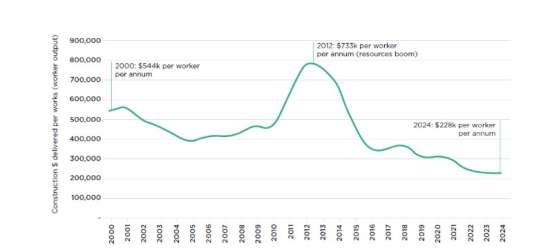
Source: Queensland Major Projects Pipeline 2025 predicated on Australian Bureau of Statistics, Arcadis
A Bifurcated Credit Environment: These operating difficulties are triggering a wave of distress, concentrated at the base of the supply chain. The construction industry accounted for 24.2% of all business insolvencies in Australia in 2025-26, with a more pronounced impact on smaller businesses.
Equifax Commercial Insights 2026 data confirms a "multi-speed" recovery: For 26Q1 vs. 25Q1. large construction businesses recently drove a 1.5% quarter-on-quarter decrease in credit demand, while small businesses saw a larger 5.6% reduction following consecutive rate hikes. Tier-1 consortiums dominating the Olympic works - now holding a significant market share - generally possess resilient balance sheets. However, if thinly capitalised Tier-3 subcontractors collapse under spot-price inflation, it triggers a domino effect of critical-path delays and ruinous penalties for the head contractors above them.
Regulatory Buffers
While the risks are severe, the Queensland Government and industry bodies are attempting to implement regulatory buffers to shield the sector.
A primary focus is managing the exact industrial relations risks that doomed the Victorian Games. The Queensland Government recently moved to scrap Best Practice Industry Conditions (BPIC) and overhaul procurement practices—a decision industry leaders claim has already "saved billions".
Historically, BPIC functioned like rigid Enterprise Bargaining Agreements, mandating premium industrial relations conditions that locked in annual wage increases (often around 5.0%) without corresponding productivity offsets. This heavy compliance burden artificially inflated labor rates and drove indirect site costs up to a crippling 45.0% of total project costs in some instances. By dismantling BPIC and pivoting to a procurement model built around making it "easy to do business," the state aims to slash these indirect costs by 10.0% to 15.0% across the board.
Furthermore, reducing procurement and environmental approval delays by just 3 to 6 months could cut non-productive indirect costs and improve overall project timeframes by 10.0%.
To combat the labour vacuum, the state introduced a $19.0m apprenticeship subsidy scheme to bring new entrants into the market. Additionally, industry bodies are heavily advocating for mutual licensing recognition across state borders, removing regulatory friction so interstate tradespeople can easily relocate to Queensland.
Conclusion
The Brisbane 2032 Olympic and Paralympic Games offer an unparalleled opportunity to secure a lasting economic legacy. However, a surging pipeline does not natively equate to a healthy industry.
For business operators, the next decade requires extreme vigilance. The multi-billion-dollar venue spend introduces an unpostponable deadline into an already saturated $127.50bn engineering market. This concentrated demand is likely to exacerbate labour shortfalls and potentially fluctuate material spot prices. While many subcontractors, particularly larger entities have adapted to this volatile environment by embedding cost escalation clauses to protect their margins, those still operating under rigid, fixed-price contracts remain acutely exposed to severe financial distress.
History suggests the megaproject curse is highly prevalent. To avoid the hollow boom—where massive order books are entirely consumed by escalating input costs—construction firms are encouraged to consider implementing rigorous margin-protection mechanisms. The contractors that navigate these challenges successfully through 2032 are likely to be those prioritising acute liquidity management and robust supply-chain counterparty risk assessment over the mere accumulation of prestige revenue.
Minimise credit risk with a 360-degree view powered by Equifax next-generation commercial credit scores and counterparty and in-depth risk assessments. Contact Equifax to learn more.
This article was written by Umar Faruqui, CFA, FCCA, Senior Ratings Analyst, Equifax
Useful reading:
The Construction Margin Squeeze Report
The Construction Insolvency Crisis
Latest insights: Visit our Market Pulse Hub for the latest Credit Trends, Market Data and Economic Insights
Bibliography
Australian Broadcasting Corporation (ABC) (2026), Premier says Victoria Park protesters shouldn't 'get between bulldozers' as work begins, ABC News.
Twyford, L. (2026), 'Queensland's construction worker shortfall to peak at 35,000 ahead of 2032 Olympic and Paralympic Games, report warns', ABC News, 17 March
Burnett, C. (2025), Builder Consortium Revealed for 2032 Brisbane Olympics, The Urban Developer.Construction Skills Queensland (CSQ) (2025), Industry Outlook 2025-26.
Department of Energy and Public Works (2021), Best practice principles: Quality, safe workplaces, State of Queensland.
Department of Housing and Public Works (2025), Queensland Procurement Policy 2026, State of Queensland.
Equifax (2025), Large businesses driving credit demand growth, Mortgage Professional Australia.
Equifax (2026), Commercial Credit Insights Q12026
Flyvbjerg, B. and Budzier, A. (2024), The Oxford Olympics Study 2024: Are Cost and Cost Overrun at the Games Coming Down?, Saïd Business School, University of Oxford.
Infrastructure Australia (2024), 2024 Infrastructure Market Capacity report, Commonwealth of Australia.
Levinson, B. (2026), Brisbane Olympics 2032 to face construction workforce shortage and potential delivery delays, The Australian Financial Review.
Queensland Government (2025), 2032 Delivery Plan, Department of the Premier and Cabinet, State of Queensland.
Queensland Major Contractors Association (QMCA) (2025), Queensland Major Projects Pipeline 2025.
Victorian Auditor-General’s Office (VAGO) (2024), Withdrawal from 2026 Commonwealth Games, Parliament of Victoria.
The information contained in this article is general in nature and does not constitute personal, financial, legal, or tax advice. It does not take into account your personal objectives, financial situation, or needs. Therefore, you should consider whether the information is appropriate to your circumstances before acting on it, and where appropriate, seek independent professional advice.
This document contains information sourced from third parties (refer Bibliography above). Equifax has not independently verified this information and accepts no liability for any inaccuracies contained in third-party data.
This collateral may contain forward-looking statements regarding future market trends or industry performance. These statements are based on current expectations and involve inherent risks and uncertainties. Actual results may differ materially from those expressed or implied.
Correct as of June 2026.
Copyright © 2026 Equifax Australia Information Services and Solutions Pty Ltd. All rights reserved. ABN 26 000 602 862.