

The latest Equifax Consumer Market Pulse (August 2026) highlights a market rebalancing where generational capacity and geographic exposure are reshaping risk profiles across portfolio books.
High Interest Rates and Cost Pressures Cool Appetite for Long-Term Secured Commitments
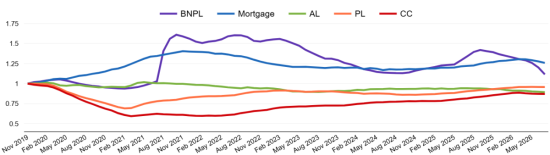
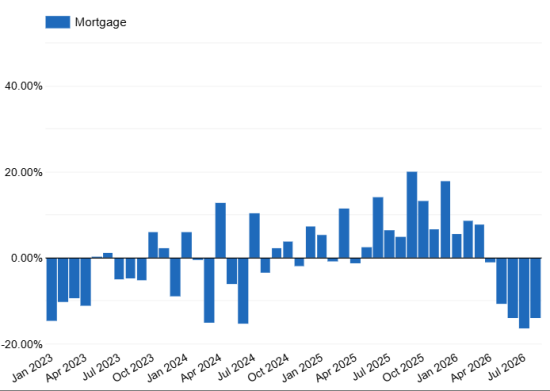
Australian households are demonstrating clear apprehension toward major financial obligations as rate pressures endure. Overall mortgage demand adjusted to -14.1% year-on-year nationally, and while slightly improved, August still marks a fifth consecutive month of demand contraction. This pullback was most pronounced across eastern jurisdictions, led by the ACT (-17.6% YoY), NSW (-15.9% YoY), and Queensland (-14.7% YoY), whereas Western Australia displayed relative resilience at -10.43% YoY.
While external lender switching remained virtually flat at -0.8% YoY nationally, internal refinancing with the same lender dropped sharply by -23.0% YoY, suggesting fewer borrowers are securing rate relief or restructures within existing credit relationships.
Simultaneously, auto loan applications softened modestly by -2.1% YoY nationally, driven primarily by reductions in Queensland (-4.8% YoY) and Victoria (-3.2% YoY), while South Australia recorded positive growth (+1.1% YoY).
First Home Buyers and Younger Cohorts Lead the Credit Retreat
The retreat from secured credit is overwhelmingly concentrated among younger demographics. First home buyer (FHB) applications plummeted -20.1% YoY nationally in August 2026 - the largest year-on-year drop recorded since 2022. State-level FHB contractions were led by Queensland (-22.6% YoY) and NSW (-22.0% YoY), reflecting worsening affordability hurdles.
This downturn directly aligns with broader age-based trends. Overall mortgage applications among 18-25 year-olds fell -21.7% YoY, while the 26–35 age cohort declined by -18.1% YoY. Despite declining participation, average loan sizes for first home buyers remain at record highs, sitting at $740,000 nationally ($622,000 for 18–25yrs and $734,000 for 26–35yrs).
Similarly, prospective property investors (borrowers with two or more mortgages) reduced application activity by -11.4% YoY in August, easing slightly from July (-15.1% YoY) and June (-12.7%YoY).
Credit Cards and Personal Loans Rebound as Households Seek Short-Term Flexibility
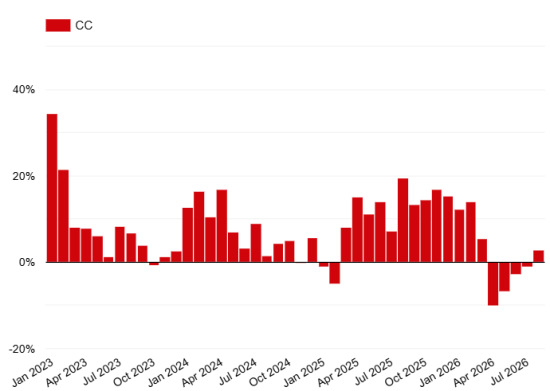
In contrast to declining secured commitments, unsecured credit categories returned to positive growth. Credit card applications grew +2.9% YoY nationally in August, breaking a four-month period of market contraction. This broad-based recovery was spearheaded by strong performance in Western Australia (+4.2% YoY) and NSW (+4.2% YoY).
Personal loan demand also rebounded to +1.3% YoY, snapping a two-month trend of year-on-year market declines. Regional divergence remains significant in the personal loan space: strong application velocity in NSW (+6.7% YoY) offset steep reductions in Tasmania (-15.3% YoY) and South Australia (-3.3% YoY).
This uptick in short-term credit facility applications is potentially driven by cardholders shopping around ahead of regulatory interchange fee cap reductions and seeking better value from alternative options.
Mature Borrowers Drive Unsecured Activity While Younger Generations Scale Back
Underlying the unsecured credit rebound is a generational divide in borrowing behaviour and financial resilience. Older Australian consumers are actively driving application volume across short-term credit facilities and refinancing channels. For credit cards, application growth was heavily concentrated in the 56+ age cohort, expanding by +21.5% YoY, compared to under-35s who contracted by an average of -2.5% YoY.
A matching trend unfolded in personal loans, where borrowers aged 56 and older drove market expansion with a +14.3% YoY surge, while demand among 26-35 year-olds fell -3.3% YoY.
Older homeowners also dominated lender-switching activity, with external refinancing growing +13.3% YoY among 56–60 year-olds and +9.2% YoY for those aged 60+. Possessing higher accumulated home equity and lower relative leverage, this mature cohort appears to leverage unsecured facilities for liquidity or rewards, whereas younger consumers remain in credit retreat across all categories.
To explore the latest credit demand trends and portfolio risk insights, visit the Equifax Market Pulse Hub.
The information in this document is for general informational purposes only and is current as of August 2026. While Equifax Australia uses reasonable efforts to ensure the accuracy of the information, we make no warranties or representations as to its accuracy, currency, or completeness. Users should verify information independently before relying on it. This collateral may contain forward-looking statements regarding future product developments or business performance. These statements are based on current expectations and involve inherent risks and uncertainties. Actual results may differ materially from those expressed or implied. This material does not constitute legal, financial, or professional advice. The recipient should seek independent professional advice tailored to their specific business circumstances before making any decisions based on the content of this document.
Copyright © 2026 Equifax Australia Information Services and Solutions Pty Ltd. All rights reserved. ABN 26 000 602 862.